
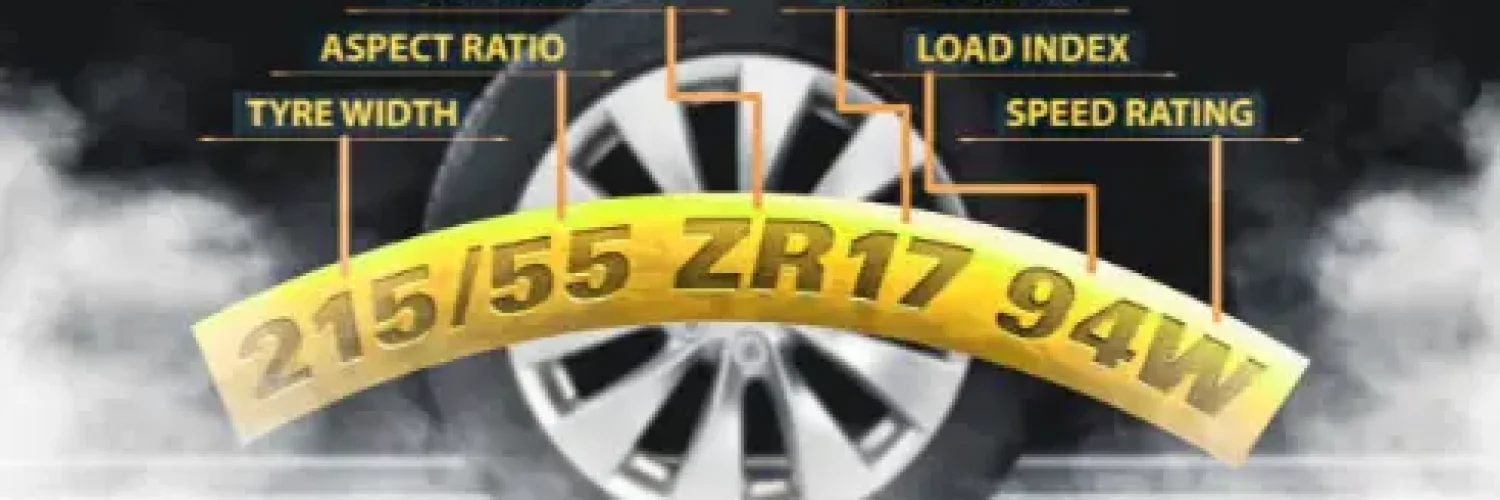
A tyre marking such as 205/55 R16 91V is a code. 205 is the tyre width in millimetres, 55 is the sidewall height as a percentage of that width, R means radial construction, 16 is the wheel diameter in inches, 91 is the load index (615 kg per tyre) and V is the speed rating (up to 240 km/h, or about 149 mph). Read together, they tell you exactly which tyre fits your wheel and whether it can carry your car’s weight at its rated speed.
This guide explains each part in plain English, works through one marking step by step with the arithmetic, and shows you how to check the right specification for your own vehicle.
205/55 R16 91V at a glance
| Marking | What it tells you | In this example |
| 205 | Nominal tyre width (mm) | 205 mm |
| 55 | Aspect ratio: sidewall height as a % of width | 55% of 205 mm = about 113 mm |
| R | Radial construction | Radial ply |
| 16 | Wheel (rim) diameter (inches) | 16 in (406.4 mm) |
| 91 | Load index: maximum load per tyre | 615 kg |
| V | Speed rating: designed maximum speed category | 240 km/h (about 149 mph) |
Where do you find your tyre size?
The full marking is moulded into the sidewall of every tyre, usually in large raised characters on the outer face. Read the numbers as one string, for example 205/55 R16 91V, and check all four tyres, as some vehicles run different sizes front and rear.
If the sidewall is hard to read, dirty or damaged, two other places show the size the manufacturer intended:
- The vehicle handbook, in the tyres or technical data section.
- The tyre information label, often on the driver’s door pillar, inside the fuel flap or on the glovebox lid, depending on the make.
Be careful with a tyre that has already been changed. The tyre on your wheel may not be the size your car was designed for, so the handbook or label is the safer reference. Never put yourself at risk checking a tyre beside moving traffic.
Worked example: reading 205/55 R16 91V step by step
Here is the same marking taken one piece at a time, with the maths behind it. The sums show why two tyres that look similar on paper can behave differently on your car.
Step 1: Width (205). The tyre is 205 mm wide, measured across the tread from sidewall to sidewall when fitted to its approved rim.
Step 2: Aspect ratio (55). The sidewall height is 55% of the width, so 205 mm x 0.55 = 112.75 mm (about 113 mm). A lower number means a shorter, stiffer sidewall. A higher number means a taller, more cushioned one.
Step 3: Construction (R). R stands for radial, the construction used on virtually all modern car tyres.
Step 4: Wheel diameter (16). The tyre fits a 16-inch wheel. In millimetres, 16 x 25.4 = 406.4 mm. This number must match your wheel exactly.
Step 5: Overall diameter. The tyre’s height from ground to top is the wheel diameter plus two sidewalls: 406.4 mm + (2 x 112.75 mm) = 631.9 mm, or about 632 mm (24.9 in).
Step 6: Load index (91). Index 91 corresponds to 615 kg per tyre. Across four tyres that is 2,460 kg of total carrying capacity, which must be at least as much as your vehicle’s axle and weight requirements.
Step 7: Speed rating (V). V means the tyre is designed for speeds up to 240 km/h (about 149 mph) under test conditions.
Why a “close” size is not the same size
Compare our example with 205/60 R16, which has the same width and wheel diameter but a taller sidewall:
| 205/55 R16 | 205/60 R16 | |
| Sidewall height | 112.75 mm | 123 mm |
| Overall diameter | 631.9 mm | 652.4 mm |
| Difference | about 3.2% larger |
A 3.2% larger rolling diameter means the speedometer reads lower than your true speed, gearing and stability systems see different wheel speeds, and the tyre may rub against arches or suspension parts. Only fit a different size if the vehicle manufacturer approves it.
What does the load index mean?
The load index is a number that corresponds to the maximum weight one tyre can carry at its correct pressure. It is not the weight in kilograms itself, so you need a lookup table. A few common values:
| Load index | Maximum load per tyre |
| 82 | 475 kg |
| 86 | 530 kg |
| 88 | 560 kg |
| 91 | 615 kg |
| 94 | 670 kg |
| 97 | 730 kg |
| 100 | 800 kg |
| 103 | 875 kg |
| 106 | 950 kg |
The index runs in small steps, so a difference of a few points is a real difference in strength. Choose a tyre whose load index meets or exceeds the figure the manufacturer specifies for your vehicle, never less.
Vans and some light commercial vehicles often show two numbers, for example 195/75 R16C 107/105R. The first load index (107) applies when the tyre is used singly on an axle and the second (105) when it is used in twin fitment, as on some rear axles. The C in the size marks a commercial tyre. If you drive a van that regularly carries heavy loads, check the exact specification before buying.
What does the speed rating mean?
The speed rating is the letter after the load index. It shows the highest speed the tyre was designed and tested to sustain while carrying its rated load. The letter is a code, not a speed.
| Speed rating | Maximum speed (km/h) | Approx. mph |
| Q | 160 | 99 |
| S | 180 | 112 |
| T | 190 | 118 |
| H | 210 | 130 |
| V | 240 | 149 |
| W | 270 | 168 |
| Y | 300 | 186 |
Two points often cause confusion:
- A speed rating is not permission to drive that fast. The UK national speed limit on motorways is 70 mph. The rating reflects laboratory test conditions and the tyre’s engineering margin, which matters for heat build-up, stability and braking at sustained speed.
- Do not assume a lower rating is fine because you drive sensibly. Your vehicle manufacturer chose a rating to suit its top speed, braking and handling. Fit the specified rating or a higher one, and ask for advice before choosing anything lower.
Other markings you may see on the sidewall
Beyond the size, load index and speed rating, the sidewall carries several other codes. These are the ones drivers ask about most:
- XL or Reinforced: an extra-load tyre built to carry more than a standard tyre of the same size. Some vehicles require it.
- RF, RunFlat or a similar run-flat mark: a tyre designed to be driven a limited distance at reduced speed after pressure loss. Replace run-flat tyres only with the type your manufacturer specifies.
- M+S: mud and snow marking. 3PMSF: the three-peak mountain snowflake symbol, which indicates the tyre has met a defined winter-performance test.
- DOT code: the last four digits show the production date as week and year. For example, 2123 means week 21 of 2023. It helps you see how old a tyre is.
- TWI: tread wear indicators, small bars in the grooves that show when tread is worn down.
Tread depth matters as much as the markings. For cars, light vans and light trailers, the UK legal minimum is 1.6 mm across the central three-quarters of the tread and around the entire circumference, and tyres must be free from cuts and defects. See the GOV.UK vehicle safety guidance.
How to match the right specification to your vehicle
The size on your sidewall is only a starting point. Work through these checks before you order a replacement:
- Find the manufacturer’s size, load index and speed rating in the handbook or tyre information label.
- Compare it with the marking on your current tyres. If they differ, find out why before copying them.
- Note whether your car uses different sizes front and rear.
- Check for special requirements: XL, run-flat, a tyre pressure monitoring system or a manufacturer approval mark.
- Confirm the load index and speed rating meet or exceed the specified values.
Common mistakes to avoid
- Matching only the width and wheel size. The aspect ratio, load index and speed rating all matter.
- Choosing a lower load index to save money. It reduces the tyre’s strength margin, especially on a loaded car or van.
- Replacing a run-flat tyre with a standard one without approval. It can affect handling and the vehicle’s systems.
- Using the maximum pressure on the sidewall as your tyre pressure. Use the vehicle manufacturer’s recommended pressure for your load.
- Treating a speed rating as a speed target. It is a design limit, not a driving guide.
Frequently asked questions
What does 205/55 R16 91V mean on a tyre?
It describes a tyre 205 mm wide, with a sidewall 55% as tall as it is wide, radial construction, made for a 16-inch wheel. The 91 is a load index of 615 kg per tyre and V is a speed rating of up to 240 km/h (about 149 mph).
What does the R in a tyre size stand for?
R stands for radial, the construction in which the internal cords run across the tyre at right angles to the direction of travel. Almost all current car tyres are radial.
What does a load index of 91 mean?
Load index 91 means each tyre can carry up to 615 kg at its correct pressure. Four tyres give 2,460 kg of total capacity, but your vehicle’s own requirements determine the minimum index you need.
Can I fit a tyre with a different speed rating?
Fit the speed rating your vehicle manufacturer specifies, or a higher one. Ask a tyre professional before choosing a lower rating, and check with your insurer if you are unsure how it could affect your cover.
Can I change my tyre size?
Only to a size the vehicle manufacturer approves. A different aspect ratio or diameter changes the overall tyre diameter, which affects speedometer accuracy, clearance and electronic stability systems.
What does C mean after a tyre size?
C marks a commercial tyre, typically used on vans. Commercial tyres often show two load indices, for single and twin fitment, so check the exact figure for your vehicle.
How do I find out how old my tyres are?
Look for the DOT code on the sidewall. Its last four digits give the week and year of manufacture, so 2123 means week 21 of 2023. Check your tyre manufacturer’s guidance on tyre age.
Not sure which tyre your car needs?
If you can read your sidewall, you now know what each number means. If the tyre is damaged, worn smooth or unreadable, tell us your vehicle make, model and registration and we can help identify the specification to check before you commit.
For a planned replacement at home or work, see our mobile tyre fitting service. If a damaged tyre has left your car unsafe to drive, our emergency tyre replacement page explains what to do next. You can also call 07490 541199 to discuss your requirements and availability.
