
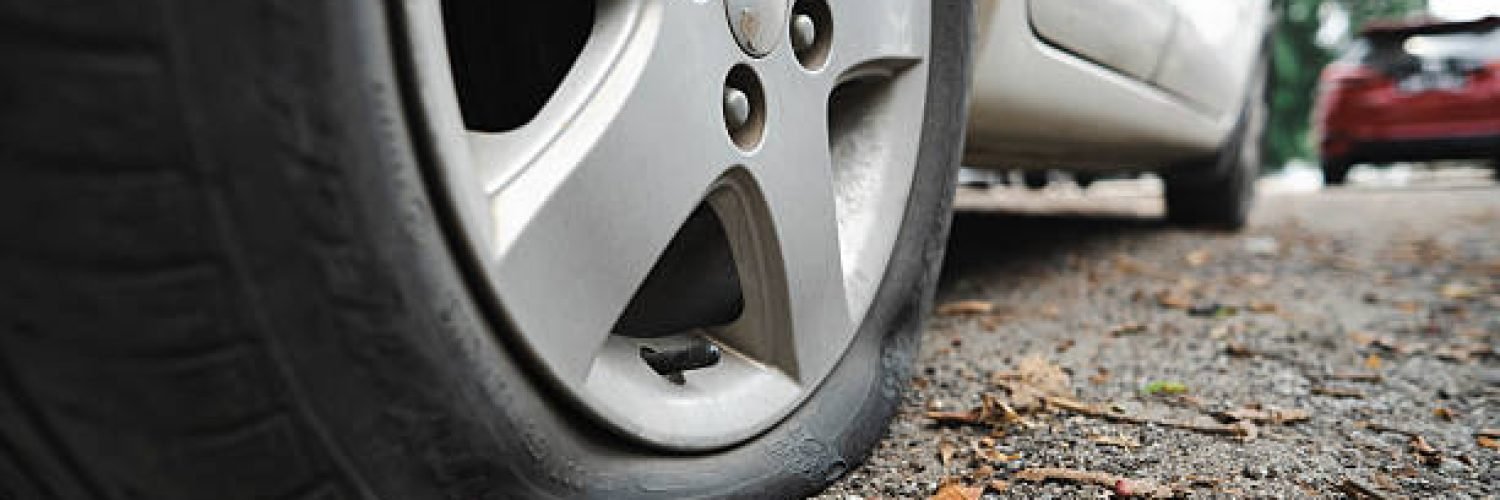
Quick answer: If a tyre goes flat or bursts while you are driving, hold the steering wheel firmly, ease off the accelerator, avoid harsh braking and slow down gradually. Switch on your hazard warning lights and move to a place of relative safety, such as a service area, lay-by or side street. On a motorway, the Highway Code says to leave at the next exit or service area if you can; otherwise move into the left lane, pull into an emergency area or onto the hard shoulder, stop as far left as possible and get yourself and your passengers well away from the vehicle and traffic. Do not attempt repairs on a motorway. Then call for help.
A tyre failure is frightening because it happens fast. The right response in the first ten seconds matters, and so does what you do after you stop. This guide walks you through both, with separate advice for ordinary roads and motorways, and explains how to decide between changing the wheel yourself and calling a professional.
Safety first: Your safety matters more than the car. If you are in a live traffic lane and cannot reach safety, stay in the vehicle with your seatbelt on and hazard lights on, and call 999. Never stand between your vehicle and oncoming traffic.
What is the difference between a flat tyre and a blowout?
The two situations feel different, and the first reaction differs slightly.
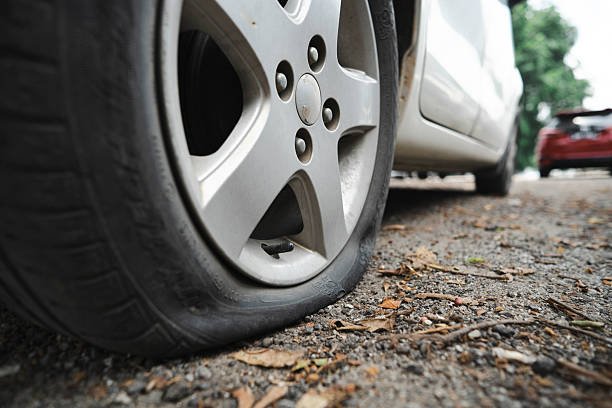
- A flat tyre (slow or gradual puncture) loses air over minutes, hours or overnight. You may notice a tyre pressure warning, a soft or vague feeling in the steering, or a tyre that looks visibly lower than the others.
- A blowout (sudden tyre failure) happens in seconds. You may hear a loud bang, feel a sudden pull to one side, notice violent vibration or see rubber debris. The car can become hard to control, especially at speed.
In both cases the tyre may be damaged beyond repair, and neither should be treated as something you can simply drive through.
Step-by-step: what to do if your tyre bursts while driving
These steps are widely recommended by UK motoring organisations. Take them calmly and in order.
- Grip the wheel firmly with both hands. The car will try to pull towards the side with the damaged tyre. Keep the steering as straight as you can.
- Ease off the accelerator smoothly. Do not lift off in a panic and do not accelerate.
- Avoid harsh braking and sudden steering. Heavy braking can upset a car that is already unbalanced. Let the speed fall gradually, then brake gently once the car is stable and slower.
- Switch on your hazard warning lights to tell other drivers you have a problem.
- Check your mirrors and signal, then steer smoothly towards a place of relative safety.
- Stop, apply the handbrake and switch off the engine.
- Get yourself and your passengers to safety, away from moving traffic (see the urban and motorway sections below).
- Call for help. Describe your exact location and the damage.
Do not drive on a deflated or burst tyre to “get a bit further”. It can destroy the wheel, damage brake and suspension parts and make the car much harder to control.
What does the Highway Code say about breakdowns and tyre failures?
The Highway Code does not have a rule written specifically for punctures, but its breakdown rules apply to any tyre failure that leaves you stopped.
- Rule 275 says to try to stop in a place of relative safety, where you, your passengers and your vehicle are less likely to be at risk from moving traffic. The safest place is a location designed for parking. On motorways and other high-speed roads, the safest place to stop is a service area. Lay-bys, emergency areas and hard shoulders are other places of relative safety, though hard shoulders give less protection because they are so close to fast traffic.
- Rule 276 covers breakdowns generally. It tells you to get the vehicle off the road if possible, use hazard lights if you are causing an obstruction, wear light-coloured or fluorescent clothing in daylight and reflective clothing at night, and never stand between your vehicle and oncoming traffic. It also covers warning triangles, which should be placed at least 45 metres (147 feet) behind your vehicle on the same side of the road, taking great care, and never on motorways.
- Rules 277 to 279 cover motorway breakdowns, including how to rejoin the carriageway and what disabled drivers should do.
You can read the full text on GOV.UK: The Highway Code: Breakdowns and incidents (rules 275 to 287).
What to do if you get a flat tyre on an ordinary road (urban, A-road or residential street)
Most flat tyres in London, Kent and Essex happen on ordinary roads, in car parks or outside your home or workplace. Here is the safe approach.
1. Find somewhere safe to stop
Look for a side street, car park, lay-by or a wide, level stretch of road away from bends, junctions and the brow of a hill. Slow down gradually and avoid stopping in a bus lane, on a pedestrian crossing or on a red route, where stopping may be restricted.
2. Make yourself visible
Switch on your hazard warning lights. If it is dark or visibility is poor, keep your sidelights on if possible. If you have a high-visibility vest or reflective jacket, put it on before you get out.
3. Get everyone out on the safe side
Get out on the kerb side, away from traffic, and ask passengers to do the same. Wait on the pavement or well away from the road. Keep children and pets under control.
4. Place a warning triangle if it is safe to do so
On an ordinary road, Rule 276 says a warning triangle can be placed at least 45 metres behind your vehicle on the same side of the road. Only do this if you can do it safely. On a bend, hill, narrow road or busy carriageway, it is safer not to walk into the road at all.
5. Look at the tyre from a safe position
Check whether the tyre is completely flat, partly deflated or visibly damaged. A sidewall bulge, deep cut, torn rubber or exposed cords mean the tyre is unsafe, and the vehicle should not be driven at all. Do not put your hands on a hot tyre or wheel after driving.
6. Decide: change it yourself or call for help
This is the key decision, and it is covered in detail below. If you are on a busy road, on a slope, on soft ground, in the dark or in bad weather, or you are not fully confident, calling for help is usually the safer choice.
What to do if your tyre bursts or goes flat on a motorway
Motorways are the most dangerous place to have a tyre problem because of the speed of the traffic around you. The Highway Code (Rule 277) sets out clear steps.
First choice: leave the carriageway. If your vehicle develops a problem, leave at the next exit or pull into a service area if you possibly can.
If you cannot, go left:
- Move into the left lane.
- Pull into an emergency area or onto the hard shoulder if you can.
- Stop as far to the left as possible, leaving space to get out, with your wheels turned to the left.
- If you can, stop just beyond an emergency telephone.
- Switch your hazard warning lights on, and use sidelights if it is dark or visibility is poor.
Then get safe:
- Exit the vehicle by the side furthest from traffic, if it is safe and possible, and make sure your passengers do the same.
- Put on high-visibility clothing if you have it and it is within easy reach.
- Get behind a safety barrier where there is one, but watch for hazards such as sudden drops, uneven ground or debris.
- Do not stand where your vehicle could be forced into you if traffic hits it.
- Do not return to your vehicle, even if it is raining, cold or dark.
- Keep passengers away from the carriageway and keep children under control.
- Animals must stay in the vehicle or, in an emergency, be kept under control on the verge.
- Do not attempt repairs on your vehicle, and do not place a warning triangle on the carriageway.
Then get help:
- Use the free emergency telephone, or contact your breakdown recovery service.
- Face the traffic when you speak so you can see anything heading towards you.
- Tell them if you are a vulnerable motorist, for example disabled, older or travelling alone.
- If you cannot exit safely or are not near an emergency telephone, call 999 and ask for the police. If your vehicle has an SOS button, you can press it and ask for the police.
How to tell them where you are
Rule 277 lists three ways to identify your location: press the SOS button if your car has one, use a mobile phone mapping app, or quote the numbers and letters on the marker posts or driver location signs along the edge of the road.
What if you are on a smart motorway with no hard shoulder?
Smart motorways may have no permanent hard shoulder. Move into the left lane, switch your hazard lights on and aim to leave at the next junction or service area, or follow the orange SOS signs to an emergency area. If you reach an emergency area, use the emergency telephone to speak to National Highways. You must follow the operator’s advice before leaving, because a lane may need to be closed so you can rejoin safely (Rule 278).
If you cannot reach an exit or an emergency area, and you cannot get out of the vehicle and well away from traffic, stay in your vehicle with your seatbelt and hazard lights on, and call 999. National Highways can then close the lane, often by displaying a red X on the overhead gantry signs.
For live advice, see the National Highways breakdown guidance: nationalhighways.co.uk/road-safety/breakdowns.
Can I change a tyre on the motorway?
No. The Highway Code says not to attempt repairs on your vehicle on a motorway. Wait in a safe place and call for assistance. Your priority is to be well away from the vehicle and behind a barrier if there is one.
Should you change the wheel yourself or call for help?
| Situation | Safer option |
| Motorway or other high-speed road | Call for help. Do not change the wheel. |
| Busy road, bend, junction or hill | Call for help. |
| Soft, uneven or sloping ground | Call for help. |
| Dark, heavy rain, ice or poor visibility | Call for help. |
| Sidewall bulge, cut, torn tyre or damaged wheel | Call for help. The wheel may need assessment as well as the tyre. |
| Locking wheel nut key missing | Call for help. |
| Level, quiet, private parking space and you are confident | Changing to a spare may be an option. |
| No spare wheel or jack (many modern cars only carry a repair kit) | Call for help. |
If you do decide to change the wheel, use the vehicle handbook. Park on firm, level ground, apply the handbrake, put the car in gear (or park for an automatic) and loosen the wheel nuts slightly before jacking. Never get under a car supported only by a jack. If anything feels unstable, stop and call for help.
A note on spare wheels, space-savers and repair kits
- Many newer cars do not carry a full-size spare. They may have a temporary “space-saver” wheel or a tyre repair kit with sealant and a compressor.
- A space-saver is a short-term fix. Check the speed limit printed on the wheel and the handbook, and replace it with a proper tyre as soon as possible.
- A sealant repair kit is also a temporary measure. It will not seal every puncture, and it does not help with sidewall damage or a blowout. If sealant has been used, tell the tyre fitter, as it can affect how the tyre is assessed.
- If you drive a car with run-flat tyres, check the handbook for the permitted speed and distance after a puncture. A run-flat tyre may have internal damage that is hard to see, so have it checked before you continue normally.
What not to do when your tyre fails
- Do not brake hard or swerve during a blowout.
- Do not keep driving on a flat tyre to reach a garage. It can wreck the tyre beyond repair and damage the wheel.
- Do not stand between your vehicle and oncoming traffic.
- Do not put a warning triangle out on a motorway.
- Do not try to change a wheel on a motorway, a slope, soft ground or beside fast traffic.
- Do not assume a tyre that still holds air is safe. A bulge, deep cut or exposed cord can mean the tyre structure has failed.
- Do not simply re-inflate and carry on if you do not know what caused the pressure loss. Something may still be embedded in the tyre, or the tyre may be damaged inside.
- Do not leave children or pets in a vehicle stopped on a live motorway lane unless you cannot safely get out and have called 999.
Can a punctured tyre be repaired, or does it need replacing?
Sometimes. A small puncture in the central tread area can often be repaired properly once the tyre has been removed from the wheel and inspected inside and out. Replacement is usually needed if:
- The damage is in the sidewall or shoulder.
- The tyre has a bulge, tear or exposed cord.
- The tyre has been driven on while flat or very low on pressure, which can damage its internal structure.
- The puncture is too large, or has been repaired before in the same area.
- The tread is at or below the legal limit.
Temporary roadside fixes such as sealant or a plug are not the same as a proper repair carried out with the tyre off the wheel. If in doubt, a technician should inspect it.
When should you call a mobile tyre fitter?
Calling a mobile tyre fitter makes sense when:
- You have a flat tyre or blowout and want it dealt with where the vehicle is parked, at home, at work or in a suitable roadside location.
- You do not have a spare wheel or jack, or you are not comfortable changing a wheel.
- The tyre has serious damage and needs replacing rather than a temporary fix.
- It is dark, raining, or you are in a place where changing a wheel yourself is not safe.
- You need help outside normal garage hours.
If you are on a motorway or stopped in a live lane, contact National Highways, the police or your breakdown provider first. A mobile tyre fitter cannot work safely in a live traffic lane, and your priority is getting to safety.
What to tell the fitter when you call
Having these details ready speeds things up:
- Your exact location or postcode, and whether you are on a private driveway, car park or roadside.
- Your vehicle make, model and registration.
- Which tyre is affected (front or rear, nearside or offside).
- Your tyre size, if you can read it safely. It looks like 205/55 R16 91V on the sidewall. Do not put yourself at risk to find it.
- What happened: a bang, a slow loss of pressure, a bulge, damage after a pothole or kerb.
- Whether the car has run-flat tyres, a locking wheel nut or any access restrictions (height barriers, permits, underground parking).
- A photo of the tyre taken from a safe position, if easy.
How Sprinter Mobile Tyres can help
Sprinter Mobile Tyres provides mobile tyre assistance across London, Kent and Essex, with a 24/7 enquiry line. Attendance depends on your location, safe access, technician availability and the right tyre being available, so we confirm the details with you before attending.
- Roadside Tyre Assistance: help when a tyre problem leaves you stranded away from home.
- Emergency Tyre Replacement: when a damaged tyre cannot be repaired and needs replacing.
- 24 Hour Mobile Tyre Fitting: enquiries outside normal garage hours.
Call Sprinter Mobile Tyres on 07490 541199 with your postcode, vehicle details and a short description of the problem, and we will discuss availability, options and the expected cost before you agree to a visit.
How to reduce your risk of a flat or blowout
Not every failure can be prevented, but regular checks help.
- Check tyre pressures regularly, including the spare if you carry one, using the pressures in your vehicle handbook or on the tyre information label. Do not use the maximum figure on the tyre sidewall.
- Check the tread. The legal minimum for cars, light vans and light trailers is 1.6mm across the central three-quarters of the tread, around the entire circumference. Many experts advise replacing tyres sooner, at around 3mm, because grip and stopping distances worsen as tread wears down.
- Look for damage. Bulges, cuts, cracks, embedded objects and uneven wear all deserve professional attention.
- Be careful with kerbs and potholes. Impacts can damage a tyre’s internal structure without leaving obvious marks. Get a tyre checked if you hit one hard and notice vibration, a pull or a bulge.
- Do not overload the vehicle beyond the limits in the handbook.
- Know where your locking wheel nut key is. Many people cannot change a wheel simply because the key is missing.
- Do not ignore the tyre pressure warning light. If it stays on, stop somewhere safe and check.
Frequently asked questions
What should I do if my tyre blows out while driving?
Hold the steering wheel firmly, ease off the accelerator, avoid harsh braking, slow down gradually, switch on your hazard lights and move to a place of relative safety. Then stop, get everyone to safety away from traffic and call for help.
Can I drive on a flat tyre to get to a garage?
You should not. Driving on a flat or severely underinflated tyre can destroy the tyre, damage the wheel and affect control of the car. If you are in an unsafe position, move only as far as needed to reach a safer place of relative safety, at very low speed, then stop and call for help.
What do I do if my tyre bursts on the motorway?
Leave at the next exit or pull into a service area if you can. If not, move into the left lane, pull into an emergency area or onto the hard shoulder, stop as far left as possible with your wheels turned to the left, switch on your hazard lights, get out on the side away from traffic and wait well away from the vehicle, behind a barrier where there is one. Use the emergency telephone or call your breakdown service. Do not attempt repairs and do not place a warning triangle on the carriageway. If you cannot get out safely, stay in the car with your seatbelt on and call 999.
How far behind my car should I place a warning triangle?
On an ordinary road, the Highway Code says at least 45 metres (147 feet) behind your broken-down vehicle on the same side of the road, if you can do so safely. Never use a warning triangle on a motorway.
Is it safe to change a tyre myself?
It can be, on firm, level ground in a quiet, safe place, if you have the right equipment and know how to do it. It is not safe on a motorway, on a busy road, on a slope or soft ground, or in poor visibility. If in doubt, call for help.
Can a tyre be repaired after a puncture?
Some can. A small puncture in the central tread area can often be repaired properly after the tyre is removed and inspected. Sidewall damage, shoulder damage, bulges, exposed cords and tyres driven on while flat usually need replacing.
What causes a tyre to burst?
Common causes include driving on an underinflated tyre, hitting a pothole or kerb, a damaged or worn tyre, overloading, and a sharp object cutting the tyre. Many blowouts follow earlier damage that was not noticed.
How do I know my tyre size?
It is printed on the tyre sidewall, for example 205/55 R16 91V. It can also be found in the vehicle handbook or on the tyre information label. A fitter should confirm the correct specification for your vehicle before replacement.
Can a mobile tyre fitter come to me at night?
Sprinter Mobile Tyres accepts enquiries 24/7. Attendance depends on your location, safe access, technician availability and tyre stock, so please call with your postcode and details to confirm.
Should I call 999 for a flat tyre?
Not for a flat tyre in a safe place. Call 999 if you are stopped in a live lane of a motorway or other high-speed road and cannot get to safety, or if anyone is in danger.
Summary
- Stay calm, grip the wheel, ease off the accelerator and slow down gradually. Avoid harsh braking.
- Use hazard lights and move to a place of relative safety. Service areas are safest on motorways.
- On a motorway: go left, stop as far left as you can, get out on the safe side, wait behind a barrier and use the emergency telephone. Do not attempt repairs.
- Never stand between your vehicle and oncoming traffic.
- If in doubt, call for help rather than changing a wheel on a busy or unsafe road.
Need help with a flat or burst tyre in London, Kent or Essex? Call Sprinter Mobile Tyres on 07490 541199.
